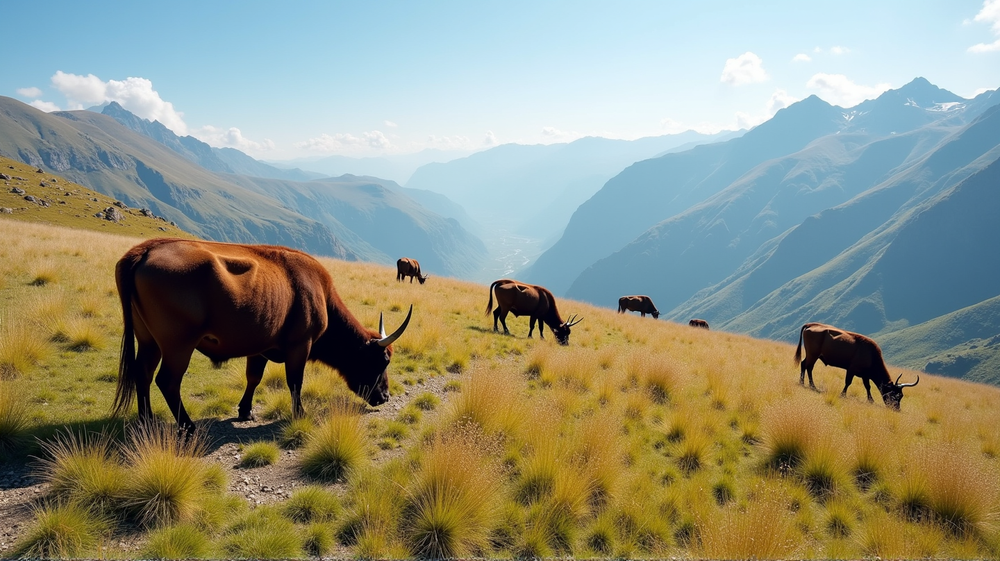
Unlocking Grassland Potential: How Moderate Grazing Boosts Productivity
In a groundbreaking revelation from China, scientists at Lanzhou University have unveiled a novel insight into the importance of moderate grazing in boosting alpine grassland productivity. This study not only sheds light on the ecological dynamics of grazing but also sets a scientific basis for sustainable land management strategies.
The Pioneers of Discovery
Conducted by experts from Lanzhou University, Nanjing University, and the Chinese Academy of Sciences, this research propels forward our understanding of ecological balance. Their collective findings, published in the respected journal Oikos, emphasize the untapped potential within functional trait spaces of plant communities, igniting a beacon of hope for sustainable agricultural practices.
Grazing’s Scientific Secret
The core of this discovery hinges on the functional trait space—a multidimensional framework where various plant traits exist. These include parameters like plant height and leaf nutrient content. Moderate grazing expands this trait space, allowing plant communities to enhance resource utilization effectively, and therefore, increase biomass production.
The Experiment that Changed Perspectives
A large-scale grazing experiment was set up at the national field scientific observation and research station in Haibei Tibetan autonomous prefecture, Qinghai province. Here, researchers assessed the impacts of different grazing intensities on plant traits across a wide array of species. Their pioneering experiment demonstrated a substantial increase in biomass production—ranging from 16.7 to 28 percent—when grazing was executed at light to moderate levels.
Implications for Future Management
As stated in China Daily, the expansion in the functional trait space strongly correlates with increased biomass, achieved primarily via improved leaf trait variation. This discovery is pivotal, marking the first time that such a phenomenon has been confirmed in alpine grasslands.
A Sustainable Path Forward
Professor He Jinsheng, a leading figure in this study, emphasizes that beyond providing a scientific framework, these findings offer critical insights for the sustainable management of alpine ecosystems. The recognition of trait space expansion as a mechanism for productivity serves as both a challenge and an opportunity for grassland conservationists worldwide.
This breakthrough not only reinforces the significance of moderate grazing in bolstering biodiversity and productivity but also presents a viable path for sustainable environmental stewardship, heralding a new chapter in the harmonious coexistence of humans and nature.